

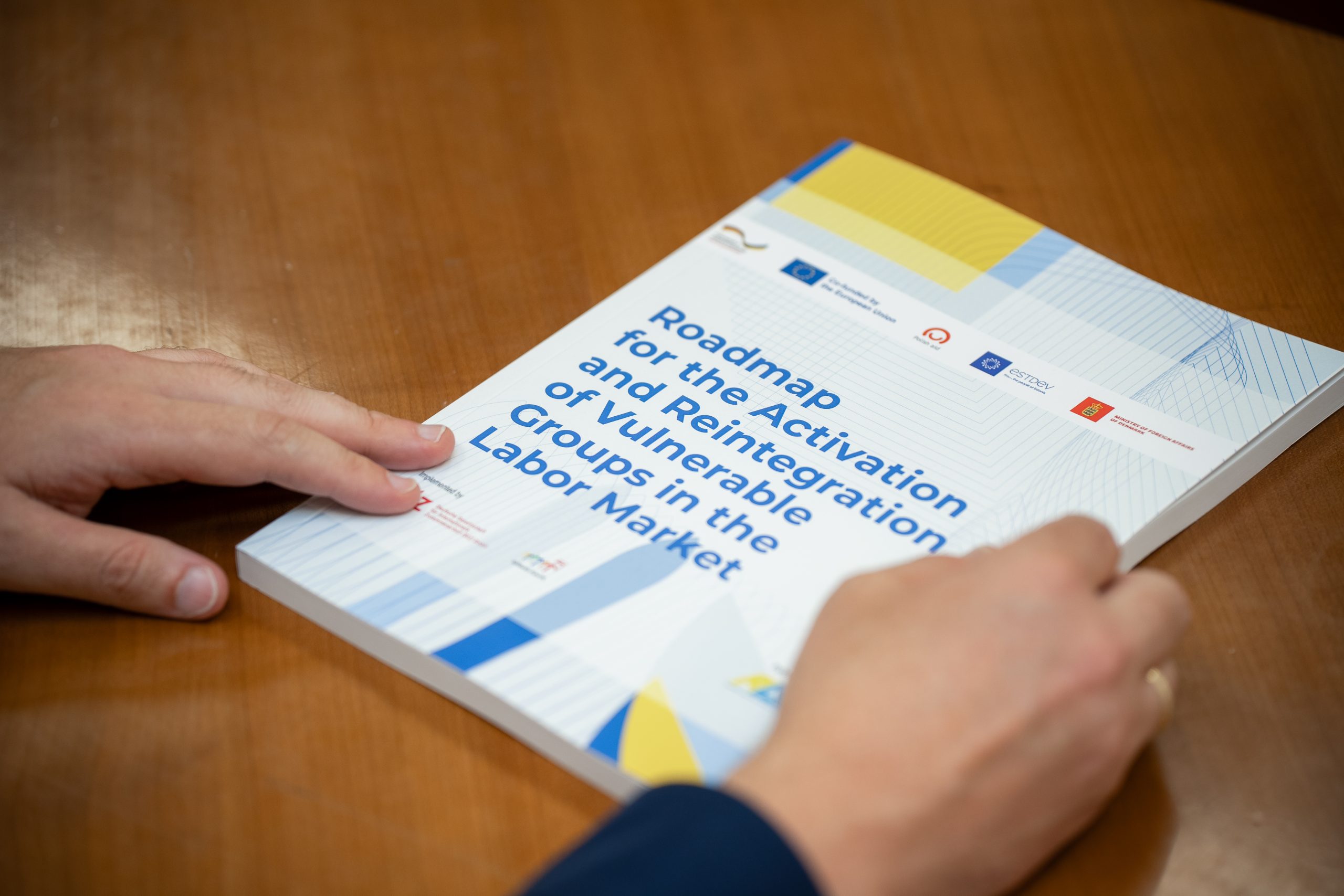
On 23 September 2026, the Roadmap for Activating and Reintegrating Vulnerable Groups in the Labour Market was publicly presented as part of the Multi Donor Initiative Skills4Recovery, with the support of the Ministry of Education and Science of Ukraine and the Ministry of Economy and Environment of Ukraine.
The Roadmap proposes practical solutions to expand access to education, skills development and employment for veterans, internally displaced people, people with disabilities, older people, women, young people and others who face additional barriers in the labour market.
Amid the ongoing war, thousands of Ukrainians have had to change jobs, retrain or rebuild their career paths, while employers continue to face labour shortages. The Roadmap proposes moving away from separate, often disconnected programmes towards a more coherent model in which education providers, employment services, employers, communities and civil society work together to support people on their path towards sustainable employment.
The Roadmap was developed by the Ukrainian Marketing Association on the basis of comprehensive research and extensive stakeholder consultations. The development of the document included mapping more than 100 stakeholders, 62 government initiatives and 81 international projects within the employment support ecosystem. Roundtables were held in Kyiv, Dnipro, Ivano-Frankivsk and Vinnytsia, bringing together 244 representatives of target groups and stakeholders, alongside 30 in-depth interviews across eight regions and focus groups in three regions.
The team also analysed more than 100 successful Ukrainian cases from businesses, state-owned enterprises, vocational education providers and civil society organisations. These included approaches to veterans’ return to work, retraining linked to employer demand, case management and cooperation between businesses and vocational education providers.
Iryna Shumik, Director General of the Directorate for Vocational Education at the Ministry of Education and Science of Ukraine, highlighted the importance of building sustainability into new initiatives from the planning stage, including in the development of inclusive vocational education.

“If we are talking about transformation, about changing the philosophy and the mechanisms, it is clear that this requires resources. Even at the planning stage, it is important to consider how an initiative will continue to work once project funding comes to an end,” said Iryna Shumik.
Bohdan Matviichuk, Director of the Employment Department at the Ministry of Economy and Environment of Ukraine, highlighted the importance of a people-centred approach to employment policy.
“People should not have to navigate the system in search of support; support should be built around the person,” he said.
One of the recurring findings of the research was the fragmentation of existing support. Ukraine already has training programmes, grants, vacancies and other support mechanisms, but people often lack a clear pathway between them — for example, from training to finding a job, or from recruitment to successful adaptation in the workplace. The Roadmap identifies these transitions between individual stages as one of the weakest links in the existing support system.
To address these gaps, the Roadmap proposes a seven-stage pathway to employment activation: from awareness and an assessment of a person’s readiness, through guidance and motivation, choosing an individual pathway and adaptation, to measuring outcomes and supporting sustainable employment and wellbeing.
Employment itself is not treated as the end point. The Roadmap stresses the need to support people after they start work and to track whether they remain in employment after six and 12 months. At present, not all programmes systematically assess such longer-term outcomes.
The Roadmap also places particular emphasis on recognising skills and competences acquired outside formal education, including through military service, previous professional experience or self-directed learning. This makes it possible to build on a person’s existing experience rather than requiring them to start their professional journey again from scratch.
During the presentation, Yuliia Martyn, Head of the Secretariat of the National Qualifications Agency, said that 287 qualification centres are currently operating in Ukraine, where people can have the outcomes of non-formal and informal learning recognised. According to her, 127 combat veterans have already been awarded professional qualifications. She stressed the importance of shortening the path from skills a person already has to a recognised professional qualification and, ultimately, to a real job.
“Ukraine already has many solutions that help people learn, change profession and find work. The task of this Roadmap is to show how these opportunities can be connected into a coherent system and how approaches that have already proved effective can be scaled up,” said Oleksii Oleksiuk, Component Lead at the Multi Donor Initiative Skills4Recovery.
The Roadmap also provides practical tools to support the implementation of its recommendations. These include the Roadmap for Implementing Dual Vocational Education in VET Institutions, the methodological guide “Care and Inclusive Learning in Vocational and Professional Pre-Higher Education Institutions”, and the “Guide to Effective Communication with Different Target Groups in Employment, Vocational Training and Human Capital Development”.
Background: The project “Roadmap for Activating and Reintegrating Vulnerable Groups in the Labour Market” is implemented by the Ukrainian Marketing Association within the Multi Donor Initiative Skills4Recovery, jointly co-financed by the European Union, Germany, Poland, Estonia and Denmark, and implemented by Deutsche Gesellschaft für Internationale Zusammenarbeit (GIZ) GmbH and Solidarity Fund PL (SFPL).