

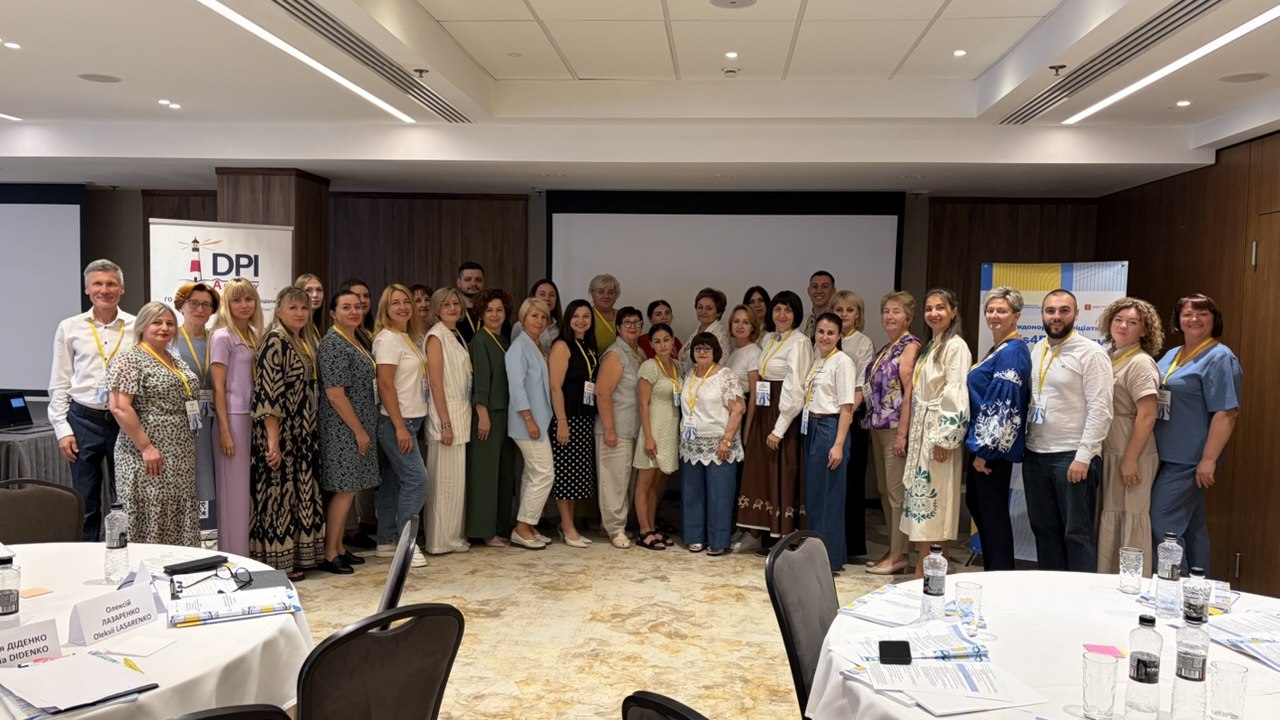
Forty-five representatives of 14 vocational education and training (VET) institutions took part in the All-Ukrainian Final Conference on Inclusive Learning Environment and Psychosocial Support in Vocational Education and Training, held on 25–26 August.
Participants reviewed the results of the project “Inclusive Support in Vocational Education and Training: Upskilling School Psychologists for Diverse Needs” and discussed how the knowledge, approaches and tools developed through the project could be shared more widely across the VET system.
The project included 13 training sessions and two working groups. It also resulted in the development of the practical guide Inclusive Support for Learners and Educators with Diverse Needs in Vocational Education, as well as two sets of practical cards for use with learners and teaching staff. Following the pilot, a professional development programme for psychologists working in VET institutions was also developed.
“An inclusive approach in vocational education starts with people and with creating conditions in which they can learn and work comfortably. Supporting staff in vocational education institutions directly strengthens the capacity of the system as a whole,” said Michael Paulo, Programme Director of the Multi Donor Initiative Skills4Recovery at GIZ.
Iryna Shumik, Director General of the Directorate of Vocational Education at the Ministry of Education and Science of Ukraine, stressed the importance of sharing the knowledge gained through the project with teachers and practical training instructors who work directly with learners.
“Education is facing new challenges that require new responses based on an understanding of trauma-informed learning and trauma pedagogy. This is why staff development is one of the key priorities for the Ministry of Education and Science and its partners,” said Iryna Shumik.
Tetyana Dovbush, Implementation Advisor for Skills4Recovery at GIZ, presented a number of initiatives aimed at strengthening the capacity of Ukraine’s vocational education system. These include the renovation of two training workshops, the provision of equipment, the development of practical resources and staff training.
She also highlighted the importance of strengthening employers’ knowledge and skills in the area of inclusion. Practical resources on inclusive employment have been developed for employers and HR professionals and are available through partner platforms and the Skills4Recovery webpage.
“Physical accessibility is an important part of inclusion, but inclusion goes much further. An inclusive approach should be embedded in the way society, communities and educational institutions operate. Veterans, people with disabilities, internally displaced people and people affected by psychological trauma may require appropriate psychosocial support and adaptations to the learning environment,” said Vitalii Panok, Acting Academic Secretary of the Department of Psychology and Special Pedagogy at the National Academy of Educational Sciences of Ukraine, Doctor of Psychology and Professor.
The impact of the training was assessed through baseline and final surveys. According to Iryna Panok, the project’s Monitoring and Evaluation Expert, 100% of respondents reported an improved understanding of inclusion and inclusive approaches, working with loss, supporting people experiencing a suicidal crisis, and providing psychological support to veterans and internally displaced people in vocational education institutions.
The project “Inclusive Support in Vocational Education and Training: Upskilling School Psychologists for Diverse Needs” is implemented by the NGO Agency for Development of Project Initiatives with financial support from the European Union, Germany, Poland, Estonia and Denmark within the Multi Donor Initiative Skills4Recovery, implemented by Deutsche Gesellschaft für Internationale Zusammenarbeit (GIZ) GmbH and Solidarity Fund PL (SFPL).