

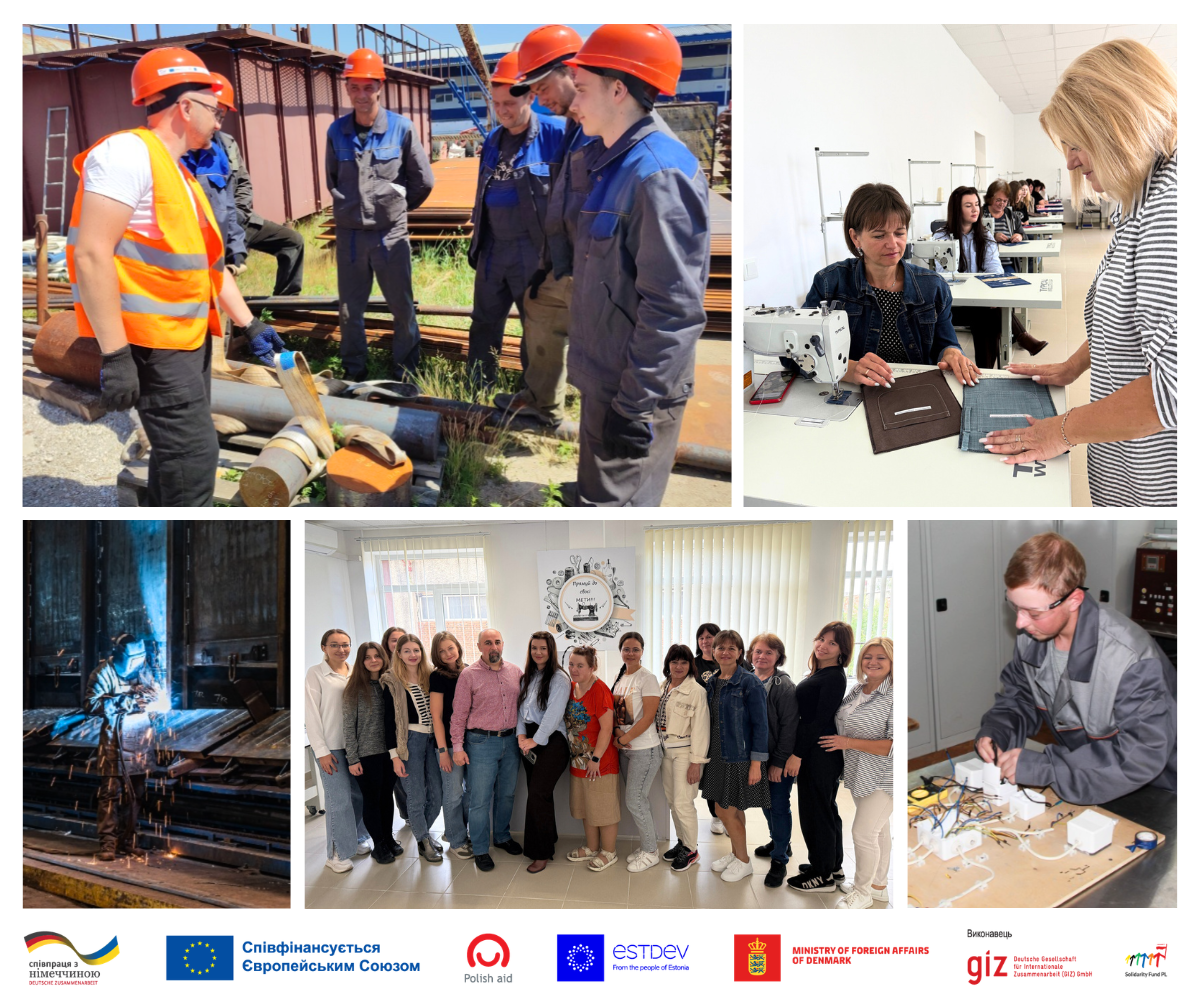
On February 11, 2026, the team of the Solidarity Fund PL in Ukraine held an online meeting with grantees under the Multi Donor Initiative Skills4Recovery. The event focused on reviewing the implementation of 8 projects delivered by Vocational Education and Training Centres of the State Employment Service of Ukraine (hereinafter VET Centres), supported through the grant call “Support for the Modernisation of Vocational Education and Training – Professional Training 2025”. The aim of the call was to improve the educational offer of the VET Centres and provide learners with additional qualifications and skills required on the labour market. Representatives of the leadership of the Department of International Cooperation and Partnership in Education of the State Employment Service of Ukraine also participated in the meeting.
Throughout implementation, the project team and experts from the Solidarity Fund PL remained in constant contact with the grantees, providing consultations, clarifications, and ongoing support, ensuring the systematic and high-quality delivery of the projects. It is also worth noting that the implementation of 17 projects across 15 vocational education institutions preparing young specialists for the processing industry is still ongoing.
The Multi Donor Initiative Skills4Recovery is jointly co-financed by the European Union, Germany, Poland, Estonia, and Denmark. It is implemented by Deutsche Gesellschaft für Internationale Zusammenarbeit (GIZ) GmbH and the Solidarity Fund PL (SFPL). Within the programme, the Solidarity Fund PL in Ukraine coordinates the vocational education component to prepare a skilled workforce for the processing industry.
In the component implemented by Solidarity Fund PL, 8 projects of the VET Centres of the State Employment Service of Ukraine were supported, targeting adults in need of upskilling or reskilling. Within the supported projects:
- 562 individuals completed vocational training and work placements with employers
- 50 co-operation agreements were signed with 40 employers
- training curricula were updated to reflect new production technologies and digital solutions, and the share of work placements was increased
- additional modules on soft skills, entrepreneurship and digital competencies were introduced
- modern production and training equipment was procured for the Vocational Education and Training Centres of the State Employment Service of Ukraine.
Performance assessment was conducted based on entry and exit surveys of learners (total sample: 562 individuals) and a survey of employers (28 enterprises), focusing on the dynamics of change.
The data demonstrate a clear increase in participants’ awareness and confidence:
- Awareness of professional requirements increased from 6.5 to 8.0
- Self-assessment of knowledge and skills — from 6.2 to 7.9
- Understanding of working conditions — from 6.5 to 7.6
- The share of participants in employment increased from 59.4% to 65.6%, while the need for additional support in finding employment decreased from 6.2% to 5.3%, indicating a gradual strengthening of graduates’ capacity to integrate independently into the labour market
- Satisfaction with the training remained consistently high: overall rating — 4.8 out of 5, including work placements at enterprises — 4.7, attitude of trainers — 4.9. Employers also positively evaluated the preparation of graduates (overall satisfaction — 4.6 out of 5)
During the meeting, particular emphasis was placed on workplace practice as the key instrument enabling the transition from training to employment. Updating curricula in co-operation with employers made it possible to focus training on the “core of the profession” and strengthen alignment with the real needs of the processing industry.
“This grant call for the VET Centres not only equipped our institutions with modern equipment, but also enabled us to train unemployed individuals who are not covered by state-funded free programmes. In this way, we were able to meet the needs of people from the open labour market by equipping them with skills that are critically important for employers,” emphasised Liliia Hrabovska, Deputy Director of the Department of International Cooperation and Partnership in Education of the State Employment Service of Ukraine.
Among the implemented areas were the training of boiler operators, gas cutters, electrical fitters, and seamstresses, as well as the introduction of courses in CNC machine operation, digital pattern cutting and 3D printing in garment production, modern metal-cutting technologies, and the automation of production processes.
The procured equipment — from sewing machines with laser cutting and CNC milling centres to solar power plant training systems and 3D printers — significantly upgraded the technical base of the centres and ensured training at a modern level.
Each supported project had its own focus and addressed the needs of its respective regional labour market.
In the Odesa Centre of Vocational–Technical Education of the State Employment Service, the project “Meeting current and future labour market needs aligned with employers’ expectations” was implemented, aimed at preparing workers for the processing industry in the southern region. Programmes were updated together with enterprises, and a significant share of the training took place directly at production sites, enabling participants to integrate more quickly into working processes.
In the Lviv Centre of Vocational–Technical Education of the State Employment Service, the project “Skills factory. Training for the processing industry” was implemented, demonstrating close co-operation with employers in western Ukraine. Training programmes for metalworking and light industry were modernised, and learning was combined with workplace practice at partner enterprises.
In the Ivano-Frankivsk Centre of Vocational–Technical Education of the State Employment Service, the project “Sewing profession as a key to economic recovery and cultural development: sewing the future together” focused on developing modern competencies in garment production. Thanks to new equipment and the introduction of digital pattern cutting, participants gained skills in demand at local light industry enterprises.
In the Dnipro Centre of Vocational–Technical Education of the State Employment Service, the project “Modernizing the future: Vocational training for all” focused on updating technical professions in an industrial region. The centre modernised its training facilities, introduced modules on production automation and strengthened the practical component of training.
In the Poltava Centre of Vocational–Technical Education of the State Employment Service, the project “Professional start: workers for the processing industry” aimed at preparing specialists for local enterprises. The main focus was on short-term programmes with a strong work placement component, enabling participants to secure employment more quickly.
In the Sumy Centre of Vocational–Technical Education of the State Employment Service, the project “Skills modernisation – energy for the future” was implemented, focusing on preparing personnel for the energy and technical sectors. The centre updated its curricula, procured modern simulators and equipment, and delivered practical training in co-operation with regional employers.
In the Rivne Centre of Vocational–Technical Education of the State Employment Service, the project “Updating educational programs in the processing industry to acquire modern qualifications and skills aligned with labor market needs” focused on adapting curricula to enterprise requirements and expanding workplace learning.
In the Kharkiv Centre of Vocational–Technical Education of the State Employment Service, the project “Training and development of general soft and hard skills for adults: “I can, I know, I believe, I live!” was implemented. Its distinctive feature was the combination of vocational training with the development of transversal skills — communication, entrepreneurship and digital literacy.
According to the results of 2025, meeting participants noted that all projects generated added value in terms of knowledge, confidence and readiness for employment, while employers demonstrated readiness for further co-operation and scaling up of these approaches.
Skills4Recovery operates as a bridge between education and the labour market — with measurable impact for jobseekers, educational institutions and enterprises in the processing industry.